Flamethrower For Sale - What To Know Before Buying
-
In the United States, flamethrowers are considered a tool and legal in every state except Maryland. In California, flamethrowers are legal if they shoot under 10 feet without permit and require a permit for further range. Our products that exceed 10 feet are altered to be compliant with California laws if shipping there.
Outside of the United States laws will vary greatly. Always check local laws before purchasing.
All products sold by Super Scorcher are to be used for their intended purpose as a tool and not as a weapon.
-
No, flamethrowers are ironically not considered firearms and are not regulated in the United States. They are classified as tools.
-
Flamethrowers in the United States are classified as a “tool” for agriculture use.
-
SFX or Special Effects Flamethrowers are a term used in the prop and effects industries of Hollywood for film & TV. Liquid Propane flamethrowers are used more often than gasoline-based flamethrowers. If you’re seen a flamethrower on TV, chances are it was actually propane based. Gasoline flamethrowers can drip flames onto the set, and the flaming liquid will land on its target unless it is far enough away that the fuel burns up mid-air. Liquid Propane burns faster than gasoline, allowing the actor or stunt-worker to shoot it without worrying about the flaming liquid landing on a target - such as an angle pointing it towards the camera. Gasoline flamethrowers are used when long range is needed for the shot. Sometimes both will be used in the same scene but for different shots, such as in Aliens.
-
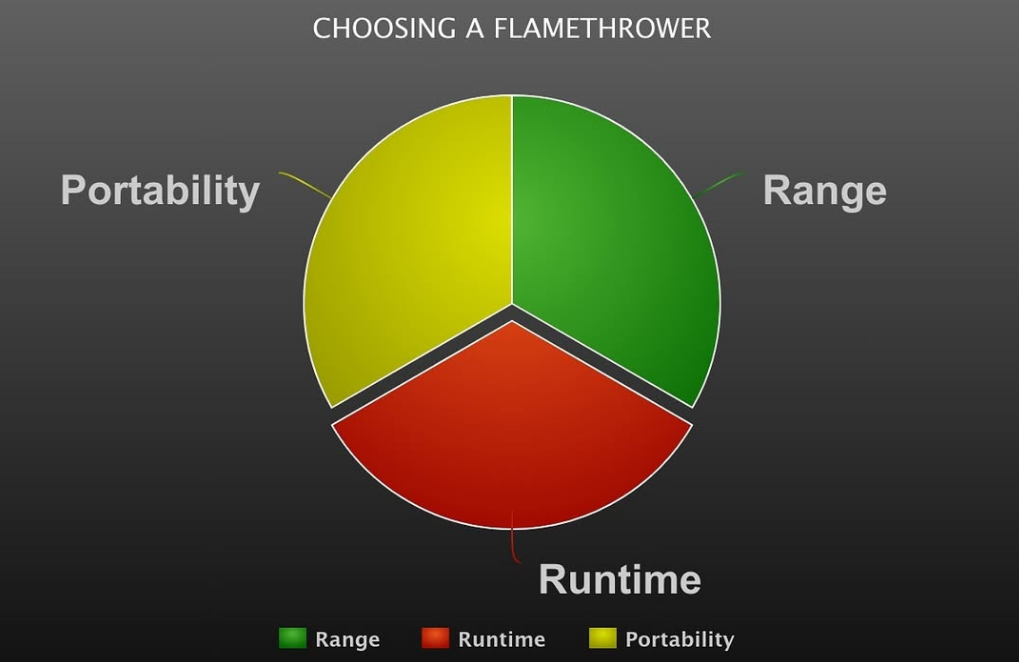
There are different types of flamethrowers, each with pros and cons of each kind. A different tool for a different job, but all 3 are a balancing act between range, portability, and runtime.
Propane vapor: Often referred to as a “poofer” or “Boosh”. This is commonly used as an effect on a stage. Using propane vapor instead of liquid fuel, this typically will be best used with larger propane tanks and equally sized empty “accumulation” tanks making the portability of them poor however has the longest run time. Relatively the safest type flamethrower.
Liquid Propane: Propane under pressure becomes a liquid. Propane liquid can have a larger flame than propane vapor without the additional accumulation chamber. Yields a larger flame than a similar sized propane vapor flamethrower, being more portable at the cost of a shorter run time. For stage performances or video - this would be the ideal handheld flamethrower. 6ft - 15ft can be achieved with liquid propane with the small portable tanks, larger can be achieved with a bigger tank.
Gasoline/Diesel: Gasoline, Diesel, or a mixture of two burn slower than propane, allowing the liquid to land on it’s target and continue to burn. There are two types of this kind: pump or C02. The downside is runtime and portability.
Handheld units using an electronic pump will be very portable but will typically have a run time of under 1 minute before they’re completely out with an average 15-25 feet. These models can often reach larger run times typically with a backpack. Often these will give several minutes of runtime.
C02 pressurized units are what is typically thought of with a flamethrower, using a backpack rig containing a fuel tank and a C02 tank to pressurize the tank of fuel. These models can reach upwards of over 120 feet, however this comes at the cost of portability and run time. Many models of this type shoot 0.5 gallons of gas per second.
We offer both gasoline and propane based models at Super Scorcher